
Website Getting Traffic but No Sales? How Conversion Rate Optimization Increases Revenue
Introduction:
You put weeks into working on your website, ad campaigns, and your SEO. Your analytics dashboard shows that there are people visiting your website regularly-yet, your shopping cart stays empty, forms aren’t filled, and your revenue stops growing.
This situation is one of the most frustrating circumstances that online entrepreneurs deal with. You pay for the audience, but you do not get any money back from it. You do not have a problem with the amount of traffic but with the conversion rate. And here comes Conversion Rate Optimization (CRO).
What is Conversion Rate Optimization (CRO)?
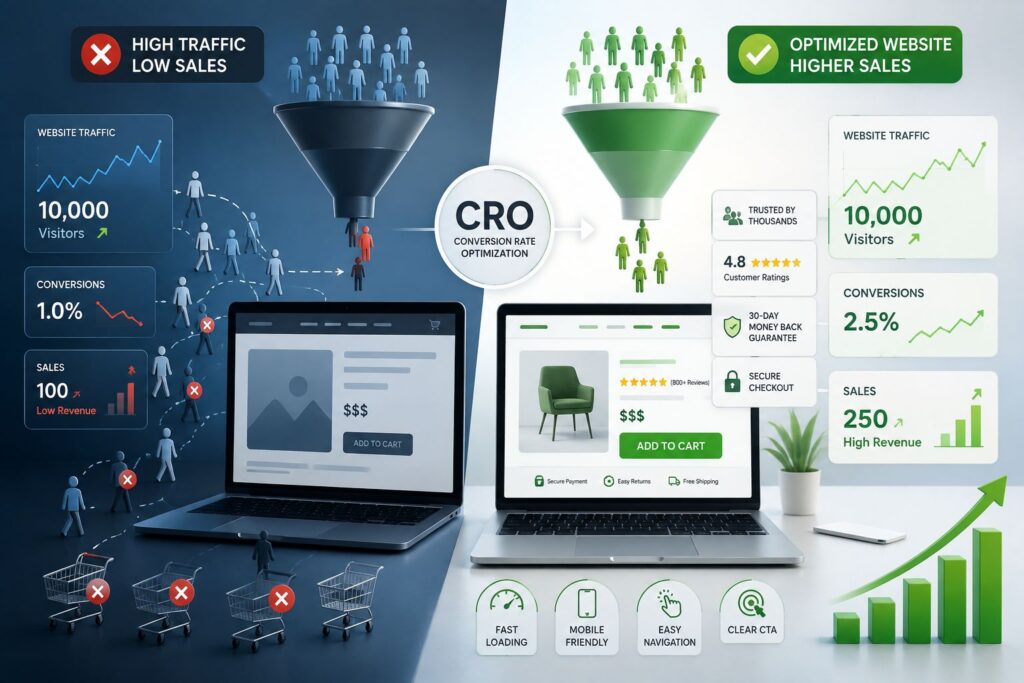
Conversion Rate Optimization is all about the endeavour made by a business to exaggerate the conversion rate of website visitors. So if your website attracts at least 10,000 visitors monthly and brings 100 sales , your conversion rate equals 1%. Implementing CRO strategies or tactics will assist you elaborate your conversion rate from 1% to 2% , which will result in doubling your profits without spending any money on attracting new clients.
Why Don't High Traffic Websites Convert?
The problems standing in the way of making a purchase when people come to your website are as follows:
- Poor UX: Bad navigation, slow website speed , invisible buttons, and other factors will stop potential customers from making a purchase immediately. If it is hard to shop, they just won’t do it.
- Misalignment Between Ads and Landing Pages: It is very frustrating for users to see a great difference between the content advertised in the ads and what is present on the landing pages.
- Lack of Trust Symbols: Visitors are usually very careful while visiting a new website. They will never purchase anything unless they see reviews, trust badges, return policies , and security of the payment system.
- Absence of Compelling Value Proposition and Weak CTAs: A poor value proposition or a CTA like “Submit” does not give buyers enough reasons to convert.
Critical Takeaway: Increase your conversion rate because that leads to a direct increase in profit, as your cost to acquire new customers stays the same while revenue grows.
Effective Approaches to Sales Optimization:
Here are the key sales optimization areas you need to focus on to make users buy your products or services:
- Remove Friction from the Checkout Process : Each additional step, input, or page refresh during the checkout creates room for reconsideration. Provide guest checkout capabilities as users don’t have to sign up. Implement autocompletion for shipping address inputs. Introduce modern solutions for one-click payments like Apple Pay, Google Pay, and Shop Pay.
- Build Trust and Reduce Risks : Doubts are the number one killer of conversions. Reduce customer doubts by placing social proof next to conversion points (next to the “Add to Cart” button). Showcase actual customer reviews, star ratings, and photos from users. Specify money-back guarantees , easy return policies , and security badges.
- Improve User Experience (UX) : Improve page loading speed-each extra second of mobile load time can decrease conversions by as much as 20%. Ensure that main calls to action and navigation items are easy to click using one’s thumb.
- Optimize Texts and Visual Hierarchy : The value proposition of your business needs to be crystal clear within 3 seconds after visitors reach your site. Male sure that your headlines emphasize benefits rather than features. Incorporate bold and eye-catching call to action buttons using effective wording.
Summary:
Spending money to increase traffic without considering conversion rate optimization means filling holes with water. You are required to adequately analyze all the things related to the website; only then will you get visitors converted into customers through user behavior analysis and specific UX improvements.