
How AI Is Transforming Digital Marketing in 2026
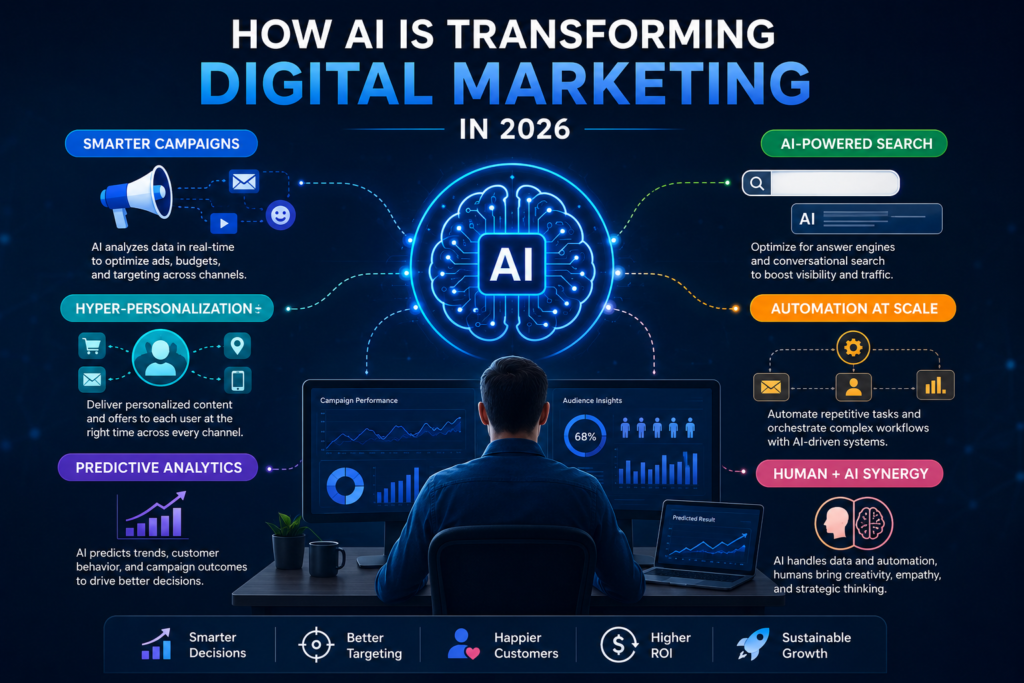
Introduction:
AI was seen not so long ago as some kind of innovation in marketing, a feature that could be described as a primitive copywriting bot or a basic chatbot, capable of responding to customer service inquiries. Today, however, AI is one of the most important aspects of digital marketing infrastructure. Not just helping people do their work in particular areas, AI is orchestrating the whole journey of each consumer through their online experience.
What is happening in the field today is a complete shift in the way companies acquire, engage, and retain customers. Instead of using static personas and manually adjusting campaigns based on certain actions, businesses use intelligent systems that analyze millions of data points per second. It is important for any company to learn how artificial intelligence can change the way they do digital marketing.
From Basic Automation to Autonomous Campaign Orchestration :
Early forms of marketing automation technology were inflexible and rule-driven. Marketers used to create logical sequences of events that made the system send predefined emails upon certain customer actions .
Despite the help these systems provided, they required constant monitoring and lacked adaptability.
Modern marketing systems function with independent reasoning capabilities. Advanced artificial intelligence software analyzes campaign goals , studies performance history data, and optimizes bids, targeting, and messaging all at once across several channels.
In case there is poor performance for a particular ad creative on a certain channel, the algorithm will automatically alter its visual design, headline, and allocate its media budget to the more efficient touchpoint without requiring any additional human intervention.
This change in approach from static to predictive automation allows marketing professionals to control campaigns easily. They don’t have to spend many hours preparing reporting dashboards or running A/B tests manually. Instead, they become strategic managers who define operational limits, set goals, and allow the intelligent algorithms to do the rest.
Hyper-Personalization on a Massive Scale:
Personalization in the field of digital marketing was associated with addressing the recipient by his or her first name in the subject line or retargeting the user according to his or her previous page views . Today’s customer demands more personalization and expects to be treated personally.
True hyper-personalization is only possible through artificial intelligence, which evaluates context-based signals like time spent on the website, purchase history, geo-location, device type, and intent signals in real-time, providing each user with a unique experience. An e-commerce homepage can change based on the visiting user’s real-time data and show them customized product collections, messages, and even personalized videos.
This kind of personalized communication is not limited to just one channel; it extends to all available communication methods. Email marketing, text messages, push notifications, and other marketing channels will no longer send the same information to the entire audience segment at specific times but will use machine learning algorithms to determine the exact moment when an individual user will interact with the message and then send them personalized content.
The Evolution of Search and Discovery :
In recent years, the world of SEO has witnessed significant changes. Intent-based discovery engines fueled by generative AI have replaced old keyword matching models. Search engines provide exact answers to users ‘ complex questions through AI-generated summaries directly in their search interface.
Therefore, organic search visibility requires a change in approach to Answer Engine Optimization (AEO). It is no longer possible to depend exclusively on high-volume keywords or backlinking. Content is built based on principles of topical authority, structure, direct answering , and deep thematic coverage. Companies need to ensure that their online materials are interpretable by artificial intelligence algorithms and form the basis of generated search results.
Additionally , image and conversational search tools have become mainstream discovery methods. Users often upload images to find similar products or use conversational search algorithms to explore complicated purchase choices.
Predictive Analytics and Data-Driven Foresight :
Traditionally, marketers relied on retrospective analysis of previous months’ performance metrics to predict future success. With the advancement of machine learning algorithms, the entire field has become one of forecasting.
Predictive analytics enables businesses to predict market trends, churn, and seasonality in customer demand. Predictive analytics can identify small signals that signify a customer is losing interest and is about to cancel his or her subscription , thus offering win-back incentives via an automated retention program.
Similarly, predictive lead scoring analyzes numerous data points from firmographics and customer engagement data, identifying lucrative leads for the business to target with their sales and marketing efforts.
The Synergy of AI and Human Marketing :
While automation solutions have been adopted at a rapid pace, artificial intelligence is not meant to replace human marketers. On the contrary, as repetitive tasks become automated through data aggregation, routine copywriting, formatting, and bidding, human emotional intelligence, creativity, and branding will become the key competitive advantage.
In fact, AI is highly efficient in pattern detection, parameter optimization, and analysis of vast amounts of data instantly. Nevertheless, human judgment is necessary to guide brand voice, earn community trust, set ethical boundaries, and generate innovative ideas to capture attention.
Conclusion:
The best companies use AI technology as an enhancement tool. By combining intelligent machines with human stories, progressive firms create marketing campaigns that are efficient and relevant for their audience.