
Creating Content Without Results? How Content Planning Improves Engagement and Business Growth
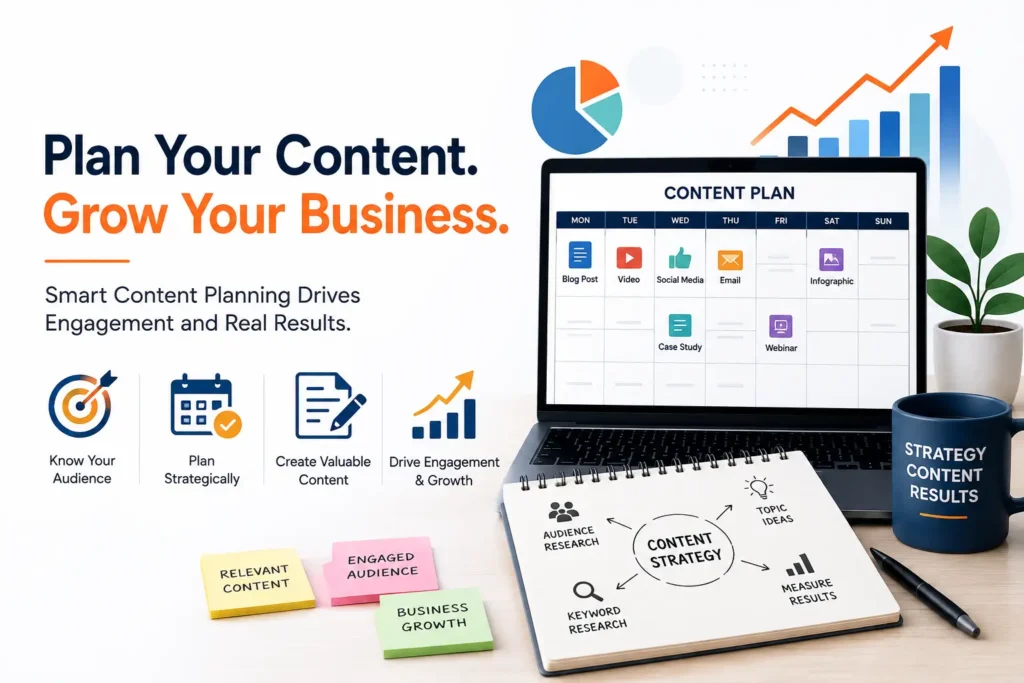
Introduction:
Posting blog entries, status updates, and tutorial videos on a weekly basis is demanding not only in terms of time but also in energy and resources. However, there are numerous content creators and marketing teams who get stuck in the never-ending cycle of producing endless content with zero engagement, web traffic, and effect on bottom-line revenues.
As soon as you see that all of your efforts do not get any reaction from your target audience, it becomes easy to conclude that the problem is the oversaturation of the market or inefficiency of content marketing. The truth is that the problem does not have anything to do with the amount of creativity or effort put into the process. In most cases, the root of the problem is the failure to plan the content creation process.
Moving from Random Acts of Content to Intentional Planning :
- Deliberate content planning helps bridge the gap between creativity and business development. This is the process of planning your publications, your audience, and your messages’ value proposition at the current moment in time and where your message should be placed in buyers’ journeys.
- Instead of waiting for sudden inspiration, a deliberately developed content strategy means each piece of content fulfills its own role. Some content creates awareness by providing educational answers to general questions, whereas some other content compares certain products in order to help buyers come to the final decision about the purchase.
Enhancing Audience Connection Through Relevant and Structured Approach :
- Audience engagement is not about counting the vanity metrics such as page views or likes on social media. Instead, engaging pieces are those that have such an impact on your reader that he or she consumes the entire material or shares it with co-workers due to your call to action.
- To achieve such an extent of connection, there is a need to conduct extensive research of the target audience at the planning stage. Analyzing the consumer feedback and search queries will give you an idea about the exact language that your consumers use.
Moreover, proper planning enables you to create logically organized groups of topics-articles are grouped by specific themes and interlinked together.
Building Local Trust with Customer Reviews and Citations
In addition to creating your primary business listing, search engines analyze your company’s reputation in the offline world and use this information to rank you in local results. Here , two important factors come into play – customer reviews and citations.
Customer reviews serve as social proof for both humans and search engines . Positive, detailed reviews indicate that customers have faith in your business, giving you additional local search authority in the eyes of search engines . Addressing every customer review – whether positive or negative – is a sign of engagement, a quality favored by search engines .
Citations consist of online references to your business’s basic info (phone number, physical address, etc.) on various directories, review sites, and chamber of commerce pages on the Web. It is crucial that the data is consistent across various directories, as inconsistencies can lead search engines to doubt the information and demote your map rankings.
Strategic Content Planning Linked With Growing Your Business :
With effective content planning, all of your media investments become a reliable, scalable mechanism for growing your business. It is not about creating content but about treating every piece of it as a business asset for the future.
When your content speaks to customer pain points, it helps to reduce the length of your sales process.
Customer education happens naturally even before any sales call-potential customers will have enough information and be pre-sold on what makes your offer unique. Strategic content planning also involves repurposing-a process that allows you to create short-form social media, email marketing, and video content out of one comprehensive guide without expanding your budget.
Turning Effort into Actionable Steps :
Producing consistent content without measurable results can be frustrating but is entirely possible to solve. The key is to stop running after the never-ending content machine and start the process of strategic planning that will ensure that every piece of content you produce has a purpose.