
AI Workflow Automation for Small Businesses
Introduction:
In the case of many entrepreneurs running small-scale enterprises, life is all about wearing too many hats at once. This includes answering queries from customers, managing the inventory, handling social media pages, and doing the billing, resulting in the vision behind starting the enterprise being buried under the avalanche of paperwork.
While big companies used to have the advantage of using large IT staff to increase efficiency, AI-driven workflows have finally evened the playing field. Modern AI isn’t confined to the simplistic “if this , then that” reasoning anymore. AI workflows act as a reasoning layer on top of your business apps, allowing for the automation of complex processes at an affordable price.
The Difference Between Traditional Automation and AI Workflows :
Traditional automation software has been on the market for well over a decade now. It follows strictly pre-defined paths: when someone fills out a form on your website, store their contact info in a spreadsheet. While practical, traditional automation software stops working as soon as the real-world data becomes vague or confusing -when a customer emails you a question in slang or sends over an invoice that looks unusual to them.
This is where AI workflow automation comes in with its intelligent, context-aware link to these processes. It does more than just transport data from A to B ; it reads receipts, understands what the customer intends, creates contextual email replies, summarizes long minutes of meetings, and makes real-time decisions based on previous data.
4 Key Business Departments Made Smoother by AI Automation :
There is no need to replace your entire software suite or hire pricey developers to deploy AI workflows. You will be able to automate high-friction areas of operations immediately when you connect AI agents to the applications you already have, like your email inbox, calendar, CRM, and accounting applications.
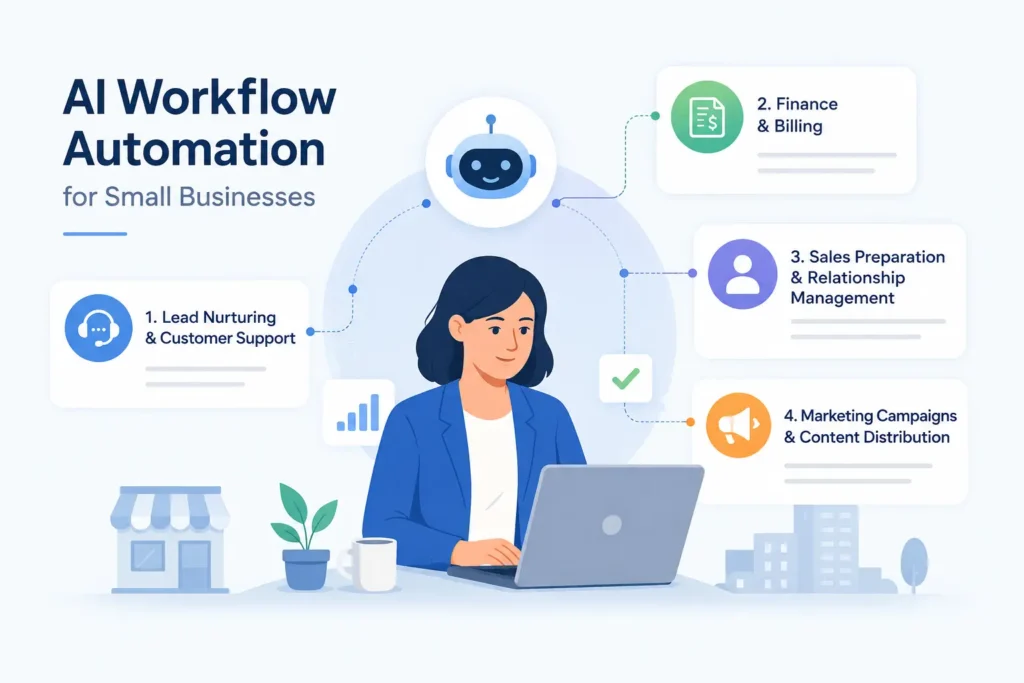
- Lead Nurturing and Customer Support: A potential client that contacts you after business hours will expect a prompt reply, yet it is impossible for a small company to monitor the email inbox at all times. With the help of AI workflows, you will receive notifications about incoming requests from websites, learn about the industry of the lead and their urgency, record everything in your CRM system, and draft a customized response email instantly.
- Finance and Billing : Manually entering information is still among the major time-drainers for SMB owners. AI extractors will automatically analyze all email attachments, retrieve any numbers from invoices provided by the vendors, put the expense categories into an accounting system, and schedule payments for approval by the manager. No more typing mistakes and no need to manually check your finances in spreadsheets.
- Sales Preparation and Relationship Management : A typical preparation for a sales call includes going through previous emails, checking social accounts, and analyzing previous deals. All these processes could be automated and included in an automated AI workflow that would prepare a summarized briefing document on your calendar invitation 15 minutes before your sales call.
- Marketing Campaigns Implementation and Content Distribution : Creating a consistent marketing campaign often takes time, as it combines strategic decisions with tedious formatting. Rather than preparing each campaign from scratch weekly, AI workflows allow extracting information from a long-form asset (a recorded webinar, for example), writing social media post captions and newsletters, and scheduling your posts.
ROI of AI for Small Businesses: What the Numbers Tell You :
The economic case for implementing AI for workflow automation lies in recovering lost productivity. As employees dedicate less time to unproductive data input activities, not only will overheads reduce, but speed-to-lead will skyrocket.
How to Get Started Without Overloading Your Employees :
One common pitfall when implementing AI in small businesses is that entrepreneurs try to automate all processes in the company simultaneously. Begin by figuring out what the most serious bottleneck within the company’s operation is and focus on tasks in which people copy and paste information between systems or ask customers the same questions repeatedly .
Conclusion:
Prototype that one task, calculate how many hours you save, and go ahead with the same approach throughout your company’s operations. As a result of delegating monotonous administrative duties to intelligent software robots, your employees will be able to deal with more strategically important issues, innovations, and the overall development of your business.