
Confused About Your Competitors? How Competitor Analysis Strengthens Your Marketing Strategy
Introduction:
It is similar to driving a vehicle in darkness without having turned on the headlights. Although you may know where you want to go, you cannot assess the dangers that lie ahead on the way to reach it . In today’s highly competitive world, it is essential for you to know what your competitors are up to and how well they are doing compared to your business.
In fact, many entrepreneurs feel intimidated by their business competitors. They fear competition in terms of price and keep imitating their advertising and promotion strategies . It is not always about keeping track of your competitors. Competitor analysis is more than just imitation; it is all about identifying opportunities and your areas of advantage.
What is Competitor Analysis in Marketing?
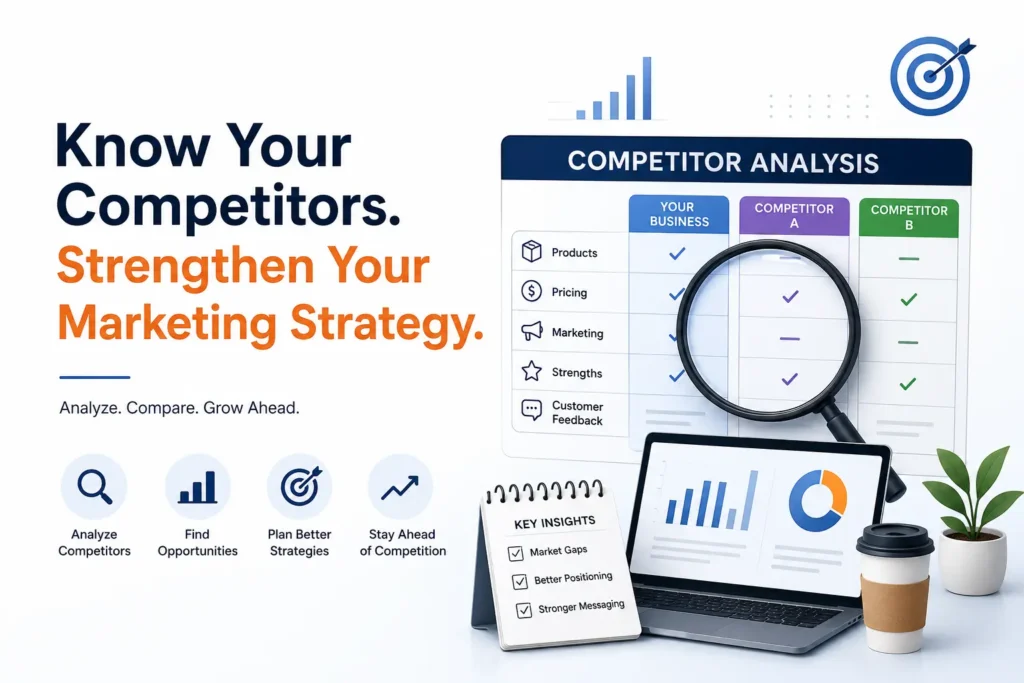
Competitor analysis can be referred to as the technique whereby an entrepreneur undertakes research and analyzes the moves made by his or her competitors. Competitor analysis does not simply involve visiting their websites or following their activities on Facebook and Twitter. It includes an analysis of various aspects of the business, such as product range, pricing schemes , marketing channels, and customer feedback, among others.
With an objective evaluation of the competitive landscape, you rid yourself of assumptions and emotions, making all your marketing decisions based on live data and market behavior patterns.
The Expensive Downside of Overlooking the Competitive Landscape :
Isolation is dangerous for brands developing within the market because companies that fail to do their competitor research face a number of predictable mistakes:
- Misallocation of Marketing Resources: Spending money on keywords, social networks, and advertising strategies that competitors have found ineffective for your market.
- Inability to Set Optimal Prices: Pricing products either too high relative to the value offered by the company or too low.
- Loss of Brand Identity: Unintentional use of messages , visuals, or value propositions similar to those used by your rivals.
Failure to See Changes in the Market Environment: Being unaware of important industry changes, technology adoptions, and new customer preferences until your market share drops.
Key Components of an Effective Competitor Strategy :
To gain a comprehensive understanding of your market environment, your competitor analysis should include several key operational components.
- Product Features and Value Propositions :
Consider the ways in which your competitors address customer needs. Analyze the features included in their solutions, their product quality, warranty periods , packaging, and customer onboarding processes. Figure out what types of value propositions they promote in their messaging headlines and which features their customers commonly appreciate or criticize.
- Pricing Strategy and Commercial Model:
Research how your competitors capitalize on their solutions. Are they charging based on subscription fees, dynamic checkout rates, flat rates , or a freemium pricing model? Understanding the way in which they charge for their solutions allows you to position your brand as a premium-quality, highly valued, or budget-friendly competitor.
- Marketing Content Presence Online:
Study the marketing distribution used by your competitors. Look at their SEO ranking, backlinks, social media channels, and pay-per-click advertisements. See which kinds of content are most effective for your competitors-whether it be long-form content, short videos, podcasts, or white papers .
- Customer Experiences & Brand Image:
Look for the customer experiences from third party review sites, forums and discussion threads on social media. What the consumers are saying about the brand in their own words will let you know what the consumers like and dislike about the brand. Complaints about your competitor’s customer support, shipping speed, or bugs in software are clear opportunities for you to offer an alternative product or service.
Competitive Analysis into a Strategy:
Collecting information alone will serve no purpose if you do not use it to make informed decisions. Post-analysis, you must convert all your findings into a strategy. The best way to apply competitor research to your strategy is by finding gaps in their market share. If all the key competitors in your industry focus solely on enterprise-level clients, there is an enormous untapped market of small business owners who would like something simpler and more affordable.
If the review analysis shows that customers dislike the complicated setup process used by the competitor, you can design your whole marketing strategy based on a simple, white-glove customer experience. Competitor analysis is not about following everyone else-quite the opposite.
Conclusion:
By knowing what your competitors are doing, you remove all ambiguity, reduce your strategic risk, and provide complete clarity in everything that you do for marketing. Instead of responding to everything that your competitors are doing, through competitive research, you can be proactive, increase market share, and create a strong brand image.